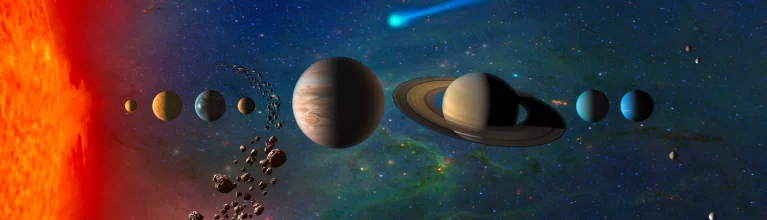
Our solar system is a vast and captivating neighborhood in space, centered around our home star, the Sun. It includes eight major planets: Mercury, Venus, Earth, Mars, Jupiter, Saturn, Uranus, and Neptune, each orbiting the Sun in its own path. These planets are divided into two main groups: the rocky inner planets (Mercury to Mars) and the gas giants (Jupiter to Neptune) further out. Beyond the planets, the solar system is filled with countless other objects. The asteroid belt between Mars and Jupiter hosts millions of rocky fragments, while the Kuiper Belt past Neptune is home to icy dwarf planets like Pluto. Comets, streaks of ice and dust, also journey through this incredible expanse. It’s a dynamic and exciting corner of the Milky Way galaxy, constantly moving and evolving.
The Solar System is a gravitationally bound system comprising the Sun—a 4.6-billion-year-old star—and everything orbiting it, including eight planets, dwarf planets, moons, and countless asteroids and comets. Located in the Milky Way’s Orion Arm, it consists of four inner rocky planets (Mercury, Venus, Earth, Mars) and four outer gas/ice giants (Jupiter, Saturn, Uranus, Neptune). The Sun contains 99.8% of the system’s mass.
Saturn, the sixth planet from the Sun and the second largest in our solar system, is a majestic gas giant instantly recognizable by its dazzling system of rings. Known since ancient times and named after the Roman god of agriculture, the planet presents a beautiful, non-twinkling point of light in the night sky. Composed primarily of hydrogen and helium, Saturn has no solid surface; instead, it is a massive ball of gas and liquid that would actually float in a large enough body of water, as it is the least dense planet in the solar system. Its most striking feature, the rings, are not solid but a vast collection of countless ice and rock particles, ranging in size from dust specks to houses, orbiting the equator. While incredibly wide (up to 280,000 kilometers in diameter), these rings are astonishingly thin, typically only about 10 meters thick. The planet itself has a rapid rotation, completing a day in just 10.7 hours, which causes it to bulge at the equator and flatten at the poles into an oblate spheroid shape. A year on Saturn, however, is much longer, equivalent to nearly 29.5 Earth years. Beyond its rings, Saturn boasts the most moons in the solar system, with 146 confirmed as of 2023, including the massive moon Titan, which is larger than the planet Mercury. Data from the NASA Cassini mission, which orbited Saturn for 13 years, provided scientists with unprecedented details about this complex system, revealing high-speed winds exceeding 1,800 km/h and massive polar storms. Saturn’s enigmatic beauty and unique characteristics make it one of the most studied and inspiring objects in our celestial neighborhood.